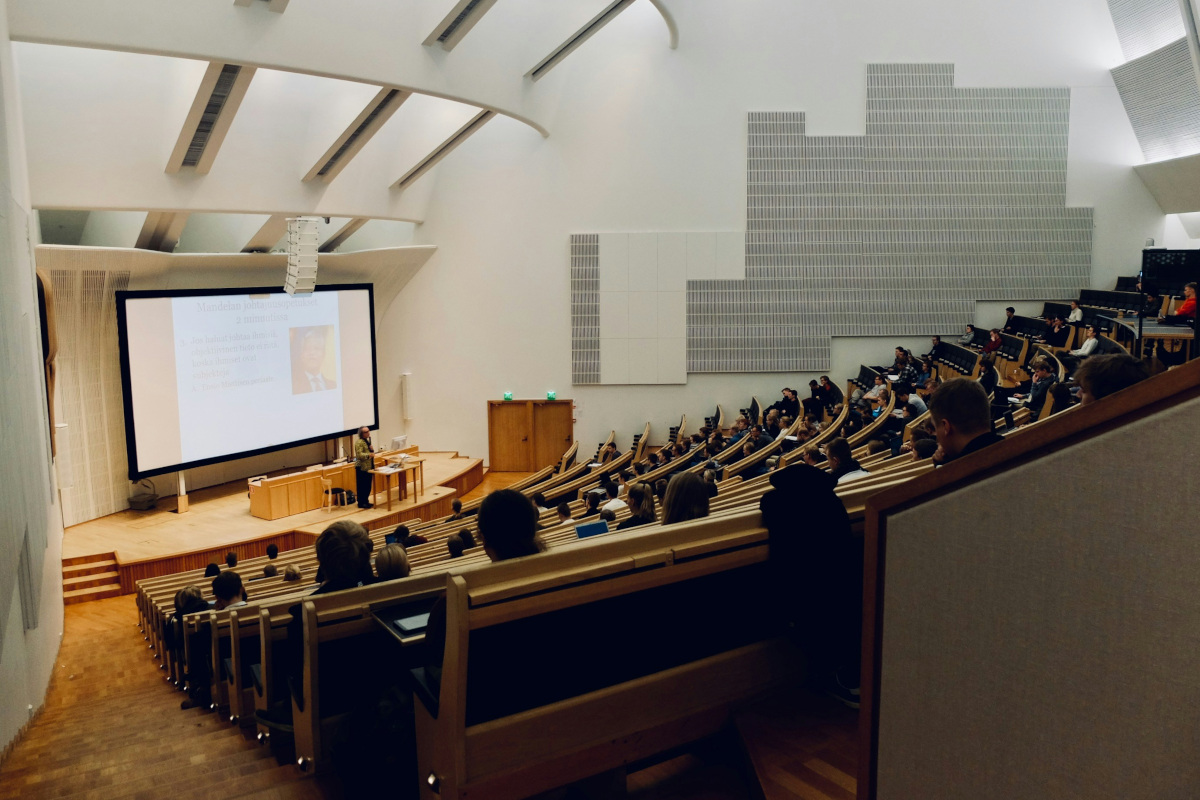
RJJ Software is pleased to share that founder and lead consultant Jamie Taylor returned to Greenhead College in Huddersfield during the week of 22 June 2026, opening the college’s “Step Into Your Future” week with a talk on artificial intelligence (AI) and setting Computer Science students a two-day challenge to build working software with the help of an AI agent. It was the third year running that RJJ Software has supported the programme, following involvement across 2024 and 2025.
The Talk: What AI Is, and What It Isn’t
Jamie’s opening session set the tone for the week. Rather than a sales pitch for the technology, it was an honest look at what AI can and cannot do in 2026, pitched squarely at students who are about to make decisions about their own futures. One of the first questions on the slides was a blunt one that many of them were already asking themselves: should I stop learning Computer Science? The short answer was no.
From there, the talk worked through how large language models (LLMs) actually produce their answers, why they can be so confidently wrong, and the difference between a tool that quietly makes decisions for you and one that presents options and leaves you in control. Jamie also covered the practical craft the students would need within hours: how to write a prompt that works, and how to give an AI agent enough context to be useful before that context eventually runs out. He was equally direct about academic integrity. An AI agent can complete an assignment, but the point of the assignment is to check the student’s own understanding, and tutors can usually tell the difference.
Two live demonstrations made the technical trade-offs concrete. Jamie ran one build using a cloud-hosted agent (Claude Code) and another entirely on local hardware, using olmx and pi with locally hosted models. Both approaches worked. The takeaway for a two-day challenge was a pragmatic one: local models are viable and well worth understanding, but the cloud-hosted models were likely to be the more useful choice for students working at speed on the hardware available to them. In keeping with RJJ Software’s technology-agnostic approach, the aim was to show the options rather than prescribe a single tool. The slides from the talk are available on GitHub.
A Two-Day Challenge, Built With AI
The challenge itself was designed in partnership with Stephen Wood, Head of Computer Science at Greenhead College. Students were split into teams of four and pointed at two public catalogues of free application programming interfaces (APIs), the Awesome-APIs and public-apis repositories, then asked to find data they genuinely cared about. Working with GitHub Copilot through their GitHub Education accounts, each team had two days to build a working application and prepare a short talk to present it.
What made the results more impressive was the starting point. Most of the students had never done any agentic development before the week, and many had never worked with an external web API at all. Jamie delivered the Monday talk and stayed on for the first few hours of the challenge to help the teams get moving, then stepped back for Tuesday and Wednesday while the students worked. He returned on the Thursday to help judge the final presentations.
What the Students Built
With the country in the middle of record heatwaves, it was no surprise that several teams reached for public weather APIs. The range of ideas beyond that was genuinely striking. Standouts included:
- A music discovery application built on the Last.fm API, which pulled additional artist information from Wikipedia and linked out to both Spotify and Apple Music.
- A Formula 1 application that let the user pick a race from the recent season and a favourite driver, then played back that car’s telemetry in real time, including speed, revolutions per minute (RPM), and steering wheel position.
- A personalised learning tool that used Wikipedia’s search API to gather material on a chosen subject, then fed it to Mistral, which used retrieval-augmented generation (RAG) to produce five multiple-choice questions for the learner.
Most teams built with Python and Tkinter, a couple reached for Node, and one team, the group behind the Last.fm application, went a step further and built a companion website that served as both the documentation for their system and the talk they delivered. It made for a close contest. The standard was high enough across the board that the teams deserve to be recognised together, rather than have any one of them singled out as the winner. It was also clear that several teams had carried on working outside college hours, using their own AI agent subscriptions; a sign of how much they had invested in what they were building.
Feedback From Students and Staff
The college shared a selection of anonymous comments from the student evaluation forms. Among them:
The talk […] at the start of the week was really informative on the matter of LLMs and the software engineering field, and the project we did was just as excellent. I appreciate the freedom we were given to formulate and develop our own projects.
I found it really insightful and a lot of fun because of the interactivity.
Built up a lot of different skills, including teamwork and problem solving.
Claire Barnes, Placement Manager and organiser of the Step Into Your Future week, also passed on feedback from college staff. The response was consistently positive: students rate the sessions highly year on year, the AI content is seen as more relevant than ever and up to date with current techniques, and the teamwork skills the project builds are valued just as much as the technical ones.
Shortly after the presentations, Jamie received a thank-you card from the Computer Science department, signed by Stephen Wood.
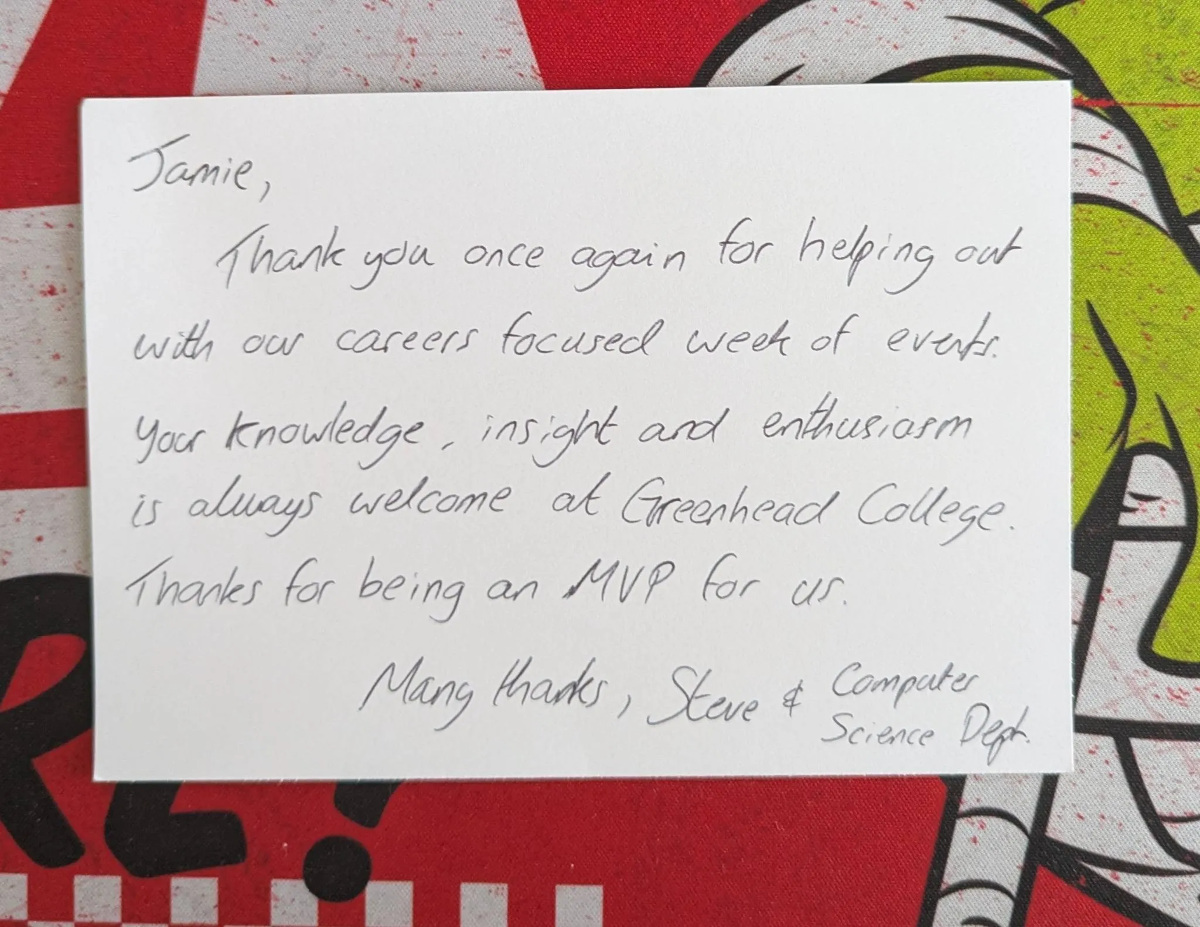
The thank-you card from Steve and the Computer Science department.
The card reads:
Jamie,
Thank you once again for helping out with our careers focused week of events. Your knowledge, insight and enthusiasm is always welcome at Greenhead College.
Thanks for being an MVP for us
Many thanks, Steve & Computer Science Dept
The MVP line raised a smile. It sits neatly alongside Jamie’s Microsoft Most Valuable Professional (MVP) award, now held for four consecutive years, though recognition from a college Computer Science department carries its own particular kind of weight.
Stephen Wood followed up by email once the week had settled, and singled out the demonstrations as one of the moments that stuck with the students:
The use of AI systems was a real eye opener for some who are now a bit more cautious when blasting out questions and requests to an AI agent.
Getting students to pause and think before firing off a prompt might be one of the more valuable outcomes of the whole week. Stephen signed off already looking forward to running it all again.
Looking Ahead
Work like this is a core part of what RJJ Software does beyond its client engagements. The company’s commitment to education was recognised at the West and North Yorkshire Chamber of Commerce Raising the Bar Awards, and weeks like this one are exactly why that work matters. Watching a group of students go from never having called an API to demonstrating working, AI-assisted software in two days is a reminder of how quickly the next generation of engineers can move when they are given the freedom to build.
Jamie is already looking forward to being part of the next Step Into Your Future week, and to seeing what the following cohort of students decides to create.
About RJJ Software
RJJ Software is a technology consultancy based in the north of England, offering fractional CTO services, software development leadership, and technology strategy to businesses of all sizes. The team works across a wide range of industries and technology stacks, helping organisations make confident, informed decisions about their technology.
To find out more about RJJ Software, visit rjj-software.co.uk.